research introduction: Adaptive Relative Orbit Control for Spacecraft Utilizing Electric Propulsion under Uncertain Disturbances
日本語字幕有り
Adaptive Relative Orbit Control for Spacecraft Utilizing Electric Propulsion under Uncertain Disturbances, Yuu Tsurusaki, Yasuhiro Yoshimura, Toshiya Hanada, Yuki Itaya, and Tadanori Fukushima
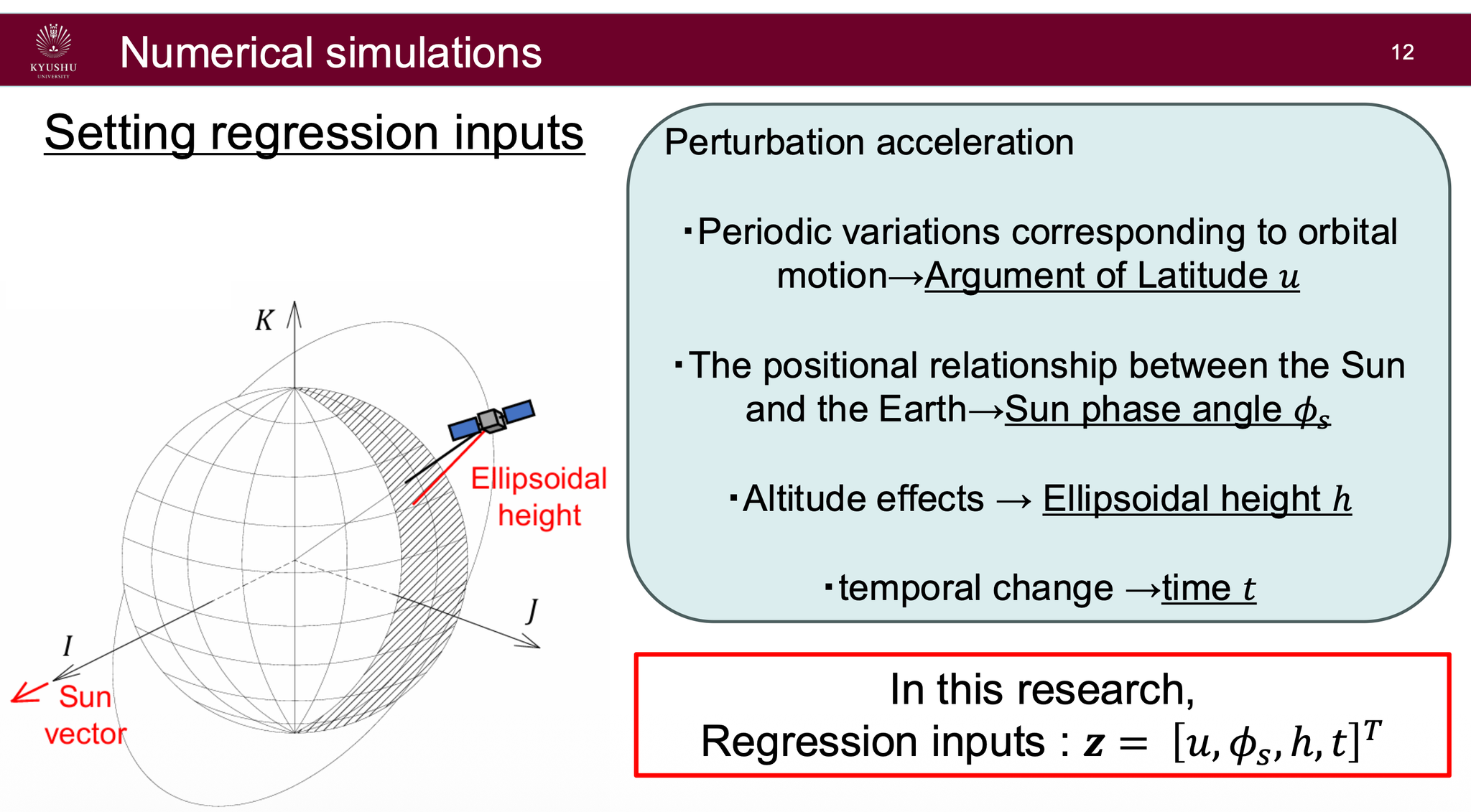
本論文は,能動デブリ除去ミッションにおいて必要となる,相対軌道の高精度な制御手法を提案している.デブリは非協力的な物体であり,質量や形状が不確実であるうえ,大気抵抗などの外乱も正確にモデル化できないという問題がある.さらに,電気推進系は ON/OFF でしか推力を出せないため,連続的な制御入力をそのまま使うことができない.そこで本研究では,「理想的な動き」を表す参照モデルに実際の衛星運動を追従させるモデル参照適応制御に,機械学習を組み合わせることで,未知の外乱をオンラインで学習・補償する方法を提案している.また,計算された連続制御入力を PWPFM により ON/OFF 推力に変換することで,実機に近い条件を考慮している.数値シミュレーションの結果,学習が進むにつれて外乱の影響が抑えられ,相対位置誤差が約 0.5 m 以内に収まることが示され,本手法が不確実な環境下でも有効であることが確認された.
This paper proposes a high-precision relative orbit control method for active debris removal missions. In such missions, the target debris is non-cooperative, and its physical properties such as mass and shape are uncertain, while disturbances like atmospheric drag cannot be modeled accurately. In addition, electric propulsion systems can generate thrust only in an ON/OFF manner, which makes it difficult to directly apply conventional continuous control laws. To address these challenges, the proposed approach combines model reference adaptive control with machine learning, enabling unknown disturbances to be learned and compensated online while forcing the spacecraft motion to follow an ideal reference model. The continuous control input computed by the controller is further converted into ON/OFF thrust commands using pulse width pulse frequency modulation, allowing realistic actuator constraints to be considered. Numerical simulations demonstrate that, as learning progresses, the effect of disturbances is effectively suppressed and the relative position error converges to within approximately 0.5 m, confirming the effectiveness of the proposed method under uncertain conditions.