intro: Long-term Evolution of the LEO Space Debris Population Under Future Climate Pathways
日本語字幕有り
Long-term Evolution of the LEO Space Debris Population Under Future Climate Pathways
Ryuji Nakawatase, Matthew Brown, Yasuhiro Yoshimura, Huixin Liu, Ryusuke Harada, Satomi Kawamoto, Toshiya Hanada
Ryuji Nakawatase, Matthew Brown, Yasuhiro Yoshimura, Huixin Liu, Ryusuke Harada, Satomi Kawamoto, Toshiya Hanada
地球温暖化は地表付近を暖める一方で、高度数百kmの超高層大気(熱圏)をむしろ冷却・収縮させ、大気密度を低下させることが知られています。大気抵抗は低軌道(LEO)における唯一の自然なデブリ除去メカニズムであるため、この密度低下は衛星やデブリの軌道滞在時間を延ばし、デブリ環境を長期的に悪化させる恐れがあります。
本研究では、気候モデルWACCM-Xに基づく熱圏密度の将来予測(Brown et al., 2024)を、JAXAと九州大学が共同開発したデブリ推移モデルNEODEEMに組み込み、IPCCの共有社会経済経路(SSP2-4.5およびSSP3-7.0)に沿った2100年までのLEOデブリ環境の長期予測を行いました。あわせて、衛星運用者がミッション終了後廃棄(PMD)の軌道設計に将来の大気変化を織り込むか否かの2通りの廃棄設計を比較しました。
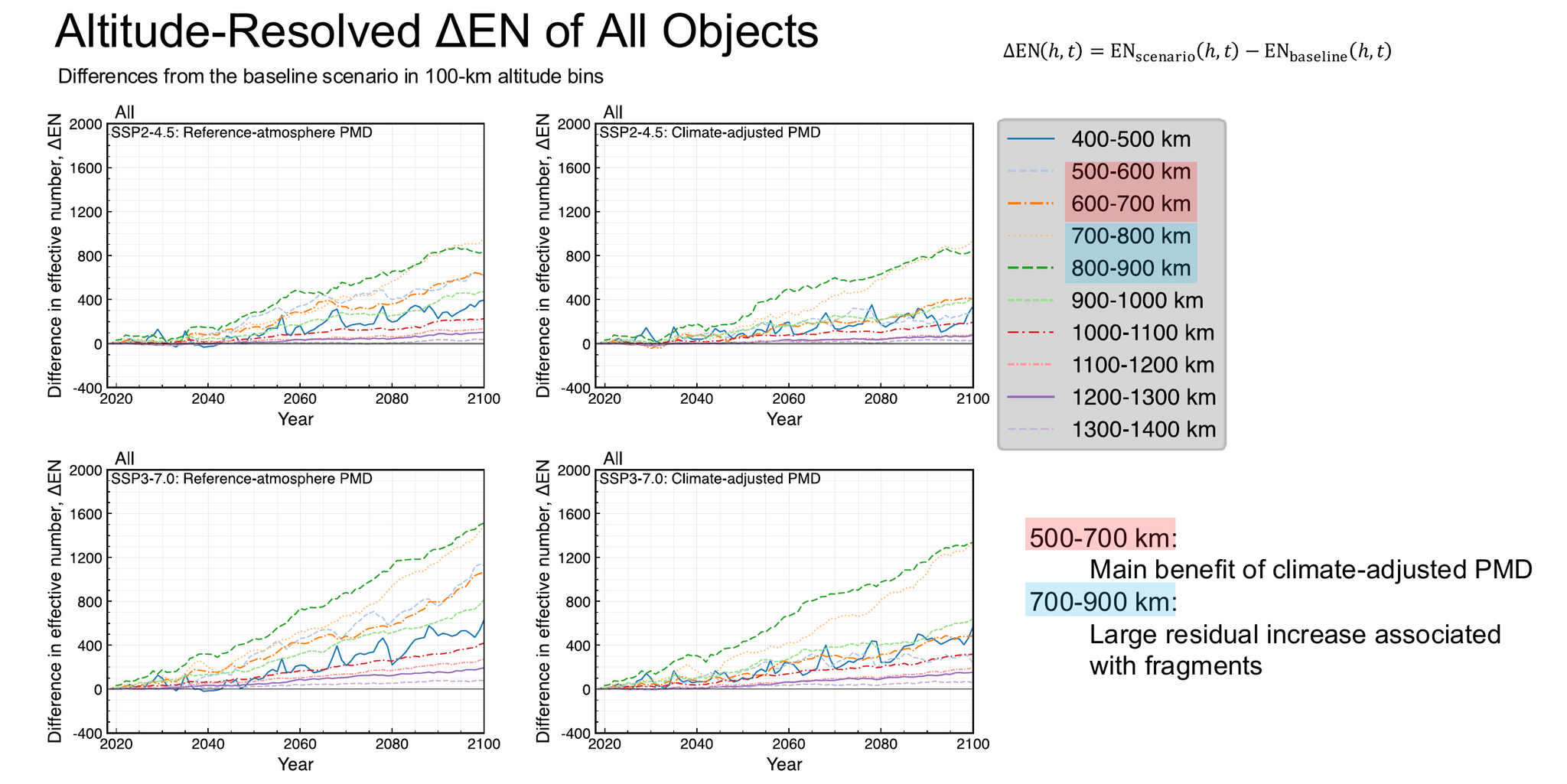
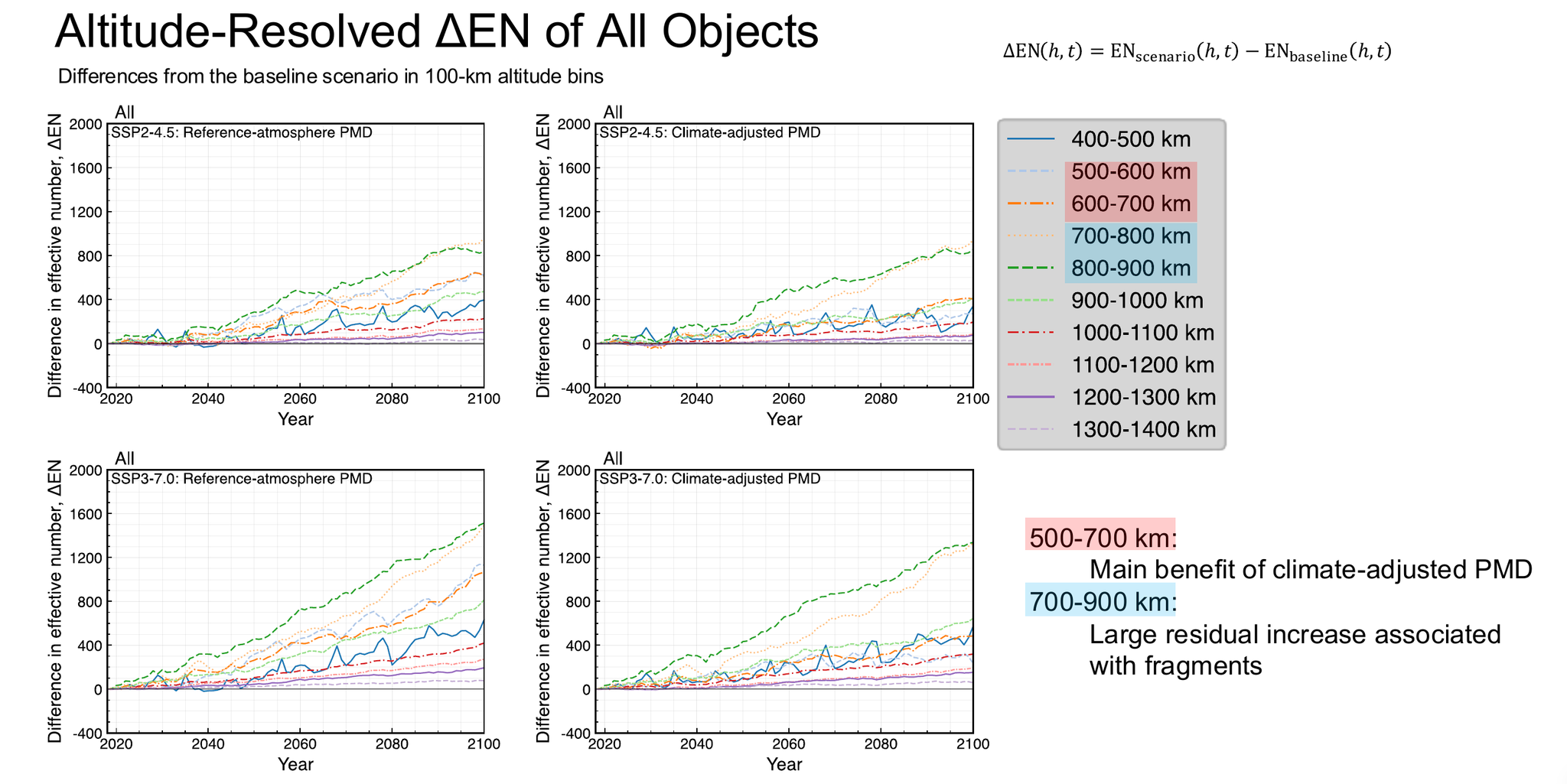
その結果、熱圏密度の低下により軌道上物体数はベースラインに比べて有意に増加し、その増加は温暖化がより進むシナリオほど大きくなることが分かりました。将来大気を考慮した廃棄設計は、高度500〜700 km帯でのペイロード・ロケット機体の蓄積を効果的に抑制する一方、衝突破片が支配的な高度700〜900 km帯の増加は抑えられません。したがって、持続可能な軌道利用には、気候変動を考慮した廃棄設計に加えて、能動的デブリ除去(ADR)などの追加対策が必要となる可能性を示しました。
While global warming heats the lower atmosphere, it cools and contracts the thermosphere at altitudes of several hundred kilometers, reducing its density. Since atmospheric drag is the only natural debris-removal mechanism in low Earth orbit (LEO), this density reduction allows satellites and debris to remain in orbit longer, potentially degrading the debris environment over the long term.
In this study, we incorporated future thermospheric density projections based on the WACCM-X climate model (Brown et al., 2024) into NEODEEM, a debris evolutionary model jointly developed by JAXA and Kyushu University, and projected the LEO debris environment up to the year 2100 under the IPCC Shared Socioeconomic Pathways SSP2-4.5 and SSP3-7.0. We also compared two post-mission disposal (PMD) designs, depending on whether satellite operators account for future atmospheric change when designing disposal orbits.
The results show that the thermospheric density reduction significantly increases the orbital population relative to the baseline, with a larger increase under the stronger-forcing pathway. Climate-adjusted disposal design effectively suppresses the accumulation of payloads and rocket bodies around 500–700 km, but cannot prevent the growth at 700–900 km, which is dominated by collision fragments. These findings suggest that sustainable use of LEO will require additional measures beyond PMD — such as active debris removal — together with climate-aware disposal design.